
🎬 1. The Beginning — When Legacy Took a New Route
In the late 1980s, when Indian households still bought snacks loose from local halwais, Shiv Ratan Agarwal saw a gap.
A descendant of the Haldiram’s family from Bikaner, he had manufacturing expertise, but he also understood one fundamental flaw in traditional Indian brands — they were family businesses, not scalable systems.

In 1987, he launched Bikaji Foods International Ltd., named after Bikaner’s founder Rao Bika Ji. The vision: create a brand that retained Haldiram’s legacy of taste but followed a modern corporate FMCG model.
The early years were quiet but strategic. While competitors expanded regionally, Bikaji focused on exports, shipping Indian namkeen to the Gulf and South-Asian markets. This move positioned it years ahead in organized exports — and built early foreign revenue streams that funded domestic scale later.
It was a lesson in patience and structure — build foundations before fame.
🧭 2. Market Context — India’s ₹45,000 Crore Snack Revolution
By FY 2024, India’s savory snacks market had crossed ₹45,000 crore, growing at 13 % CAGR (Source: Economic Times Retail 2024).
The sector was dominated by four archetypes:
- Heritage brands – Haldiram’s, Bikaji, Balaji
- MNCs – PepsiCo, ITC
- Modern FMCG hybrids – Too Yumm, Yellow Diamond
- D2C disruptors – Snackible, Open Secret
In this clutter, Bikaji carved the organized regional niche: an Indian brand with the quality of MNCs and the authenticity of heritage.
🧪 3. Product Innovation — The R&D Behind Every Crunch
When most legacy snack makers relied on traditional formulas, Bikaji built an internal R&D center in Bikaner in 2004.

It invested in:
- Dehydration tech for longer shelf-life.
- Automated spice blending for flavor consistency.
- Nitrogen-flushed packaging to meet export standards.
Between 2010 and 2024, the company expanded into 45 + SKUs:
- Bhujia, Namkeen, and Papad (heritage core)
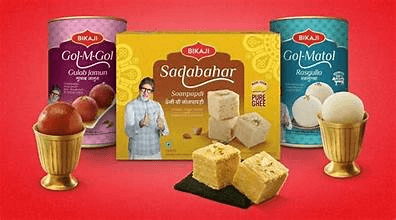
- Sweets & Soan Papdi (celebration category)
- Frozen snacks (urban quick meals)
- Fusion offerings (“Chatpata Stix”, “Masala Peanuts”)
This portfolio allowed Bikaji to mirror Parle-G’s mass-market scalability — simple, low-cost products with wide distribution, yet flexible enough for premium gifting packs.
⚙️ 4. Process Before Promotion — The Manufacturing Moat
While competitors chased advertising, Bikaji chased efficiency.

It built six fully automated plants across Bikaner, Mumbai, and Guwahati with ISO-certified lines producing 400 tons per day.
This ensured:
- Uniform taste across geographies
- Lower unit costs (economies of scale)
- Zero dependency on third-party vendors
As seen in Yubi’s success story, structure wins over sentiment. Bikaji applied that corporate discipline to an industry still run like family kitchens.
📊 5. Financial Performance — The Numbers Behind the Name

| Fiscal Year | Revenue (₹ Cr) | YoY Growth | EBITDA Margin | Net Profit (₹ Cr) | Notes |
| FY 2020 | 1,074 | — | 8.7 % | 56 | Pre-IPO baseline |
| FY 2022 | 1,620 | +51 % | 9.8 % | 76 | Pre-listing expansion |
| FY 2023 | 1,940 | +19 % | 10.3 % | 89 | IPO year |
| FY 2024 | 2,320 | +19.6 % | 10.9 % | 98 | Automation benefits |
The ₹881 crore IPO in 2022 not only funded automation but also established governance credibility — something that made institutional investors view Bikaji as India’s next mid-cap FMCG story.
🏪 6. Distribution Dominance — From Streets to Shelves to Screens
🏠 Domestic Penetration
- 2.5 lakh + retail touchpoints
- 500 + distributors
- ₹5 and ₹10 price packs for rural India
- Tier II and III focus (Bihar, Rajasthan, UP, Assam)
🌍 Export Footprint
- 35 + countries (25 % revenue)
- Early-mover advantage in GCC and US ethnic stores
This dual-channel play reflects the segmentation logic of MoneyView’s credit strategy: serve both Bharat and India with tailored formats.
📢 7. Marketing Evolution — From Nostalgia to National Pride
Between 2018 and 2024, Bikaji redefined its brand voice.
Old Positioning: “Traditional Taste from Bikaner.”
New Positioning: “Be Indian, Eat Indian.”
Campaign Highlights
- “Bhujia Ki Shaan, Desh Ka Naam” – 2021 patriotic TV spot.
- IPL Sponsorships – Rajasthan Royals, 2023.
- Festival Boxes – Diwali and Holi regional edition launches.
Bikaji’s tone now mirrors CXR Agency’s creative model: cultural resonance executed through modern storytelling.
💻 8. Digital Transformation — The Phygital FMCG
Bikaji launched its D2C site in 2021 (official website) and simultaneously built partnerships with Amazon, BigBasket, and Blinkit.
Their online model wasn’t about discounting; it was about data visibility.
By 2024, 20 % of revenue came from digital channels — up from 10 % in FY 2022.
Their “phygital” approach—using offline sales data to trigger regional digital ads—reduced marketing waste by nearly 15 %.
A report by Economic Times Retail 2024 notes that this hybrid strategy allowed Bikaji to protect margins even during inflationary periods when competitors lost market share.
🧩 9. Competing Without Cannibalizing
Despite sharing heritage with Haldiram’s, Bikaji never positioned itself as a rival — it built its own lane.
| Brand | Core Identity | Pricing | Channel Focus | Governance |
| Haldiram’s | Family-run heritage | Mid-premium | Retail & QSR | Private |
| Bikaji | Corporate FMCG | Accessible mid-tier | Retail + E-com + Export | Public |
| Balaji | Regional mass | Low | Offline | Private |
| Prataap Snacks | Modern youth | Value | Offline + Festivals | Listed |
Bikaji positioned itself in the “organized regional FMCG” segment — scalable and trustworthy, with enough emotional connect to retain loyalty.
⚠️ 10. Challenges — Growth Isn’t Without Heat
- Raw Material Inflation: Gram flour & edible oil costs rose 20 % in FY 2023. Margins compressed briefly.
- Regional Competition: Balaji and Yellow Diamond pose price pressure in North India.
- Retail Fragmentation: Kiranas still dominate rural distribution; credit cycles slow cash flow.
- Digital Competition: New-age snack D2Cs grabbing urban mindshare with vegan & protein claims.
Yet Bikaji’s discipline in process and pricing has kept EBITDA margins steady — a rare feat for snack brands.
💡 11. Strategic Takeaways — The Bikaji Blueprint
| Lesson | Strategic Insight |
| 1. Professionalize legacy. | Turn family brands into corporate entities to scale beyond bloodlines. |
| 2. Own your manufacturing. | Production control creates pricing power. |
| 3. Diversify intelligently. | Expand within adjacent snack formats first. |
| 4. Regionalize branding. | One India, many cultures — customize messaging accordingly. |
| 5. Use IPO as momentum, not exit. | Public listing is leverage for capital and credibility. |
| 6. Balance offline and online. | Digital cannot replace retail — they must coexist. |
💬 12. Conclusion — From Kitchens to Capital Markets
Bikaji’s story is India’s FMCG transformation in one frame: heritage meeting discipline.
From the lanes of Bikaner to the NSE ticker, the brand proved that you don’t need venture capital to scale — you need vision and systems.
Like Levi’s India success story, Bikaji modernized without losing its core ethos.
It is no longer just about selling bhujia — it’s about exporting trust, process, and pride.
📬 Running a Legacy Brand That Needs Structure?
🚨 You’ve built trust for decades, but your brand isn’t scaling?
📉 Your operations work like a factory, not a brand machine?
💡 Let’s structure your growth like Bikaji — with data, discipline, and distribution.
👉 Fill this form to get your “Legacy-to-Scale Audit” – Free


We’ll review your brand’s narrative, systems, and content and send a custom report with actionable steps.
