
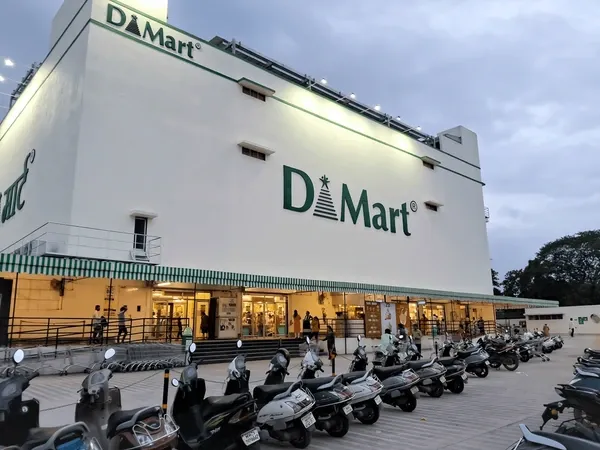
Most retailers compete with:
- Bigger stores
- Louder advertising
- Flashy discount festivals
D-Mart competed differently.
It built a financial system so efficient that it became its own marketing engine.
This is the story of D-Mart and the negative working capital loop that most retailers understand but very few can execute.
Welcome to Street Smart Brands of India — Day 6.
D-Mart Is Not a Branding Story
Founded by Radhakishan Damani, D-Mart entered Indian retail with a simple idea.
Keep costs structurally lower than competitors.
Not temporarily lower.
Structurally lower.
That difference is everything.
Unlike retailers that depend on heavy branding, D-Mart rarely invests in celebrity endorsements, large campaigns, or festival hype.
Its advantage is built inside spreadsheets, not billboards.
The Strategic Bet: Ownership Over Rental
While many retailers expanded rapidly through expensive mall rentals, D-Mart focused on:
- Buying land outright
- Locking long-term leases early
- Expanding gradually, not aggressively
This reduced fixed costs significantly over time.
Retail margins are thin. Often between 3 to 6 percent.
If you shave off even 1 to 3 percent from operating costs, the impact compounds massively at scale.
D-Mart built its model around that math.
This operational discipline mirrors how OfBusiness embedded credit into procurement rather than chasing branding, as explained in the OfBusiness marketing strategy.
The Vendor Power Move
Here is where the real street-smart play begins.
Most retailers pay suppliers in 30 to 60 days.
D-Mart typically pays in about 7 to 10 days.

For suppliers, faster payment means:
- Lower working capital stress
- Faster inventory turnover
- Greater predictability
In exchange, D-Mart negotiates an additional 2 to 3 percent discount.
In grocery retail, 2 percent is not small.
It is survival.
The 2–3 Percent Structural Edge
Because D-Mart pays early, it earns pricing power.
And here is the masterstroke.
Instead of retaining that extra margin entirely, D-Mart passes a significant portion of it to customers through consistently lower prices.
Not festival discounts.
Not one-day offers.
Everyday price advantage.
Customers notice.
Families compare monthly bills.
Word spreads organically.
Price perception builds naturally.
This turns cost efficiency into marketing.
The Marketing That Isn’t Marketing
D-Mart spends negligible money on advertising compared to other major retail chains.
No heavy celebrity campaigns.
No big-budget TV ads.
No constant discount announcements.
Its positioning is simple.
Be predictably cheaper.
And let customers become the promoters.
This pricing-driven word of mouth mirrors how Meesho built trust among value-conscious consumers without premium branding, as explored in the Meesho marketing strategy.
Both brands understood something powerful.
Value speaks louder than visibility.
The Negative Working Capital Loop
This is the financial engine underneath.

Customers pay D-Mart instantly at checkout.
Inventory moves quickly due to high footfall.
Suppliers are paid within 7 to 10 days.
In many cases, cash enters before it exits.
This creates a negative working capital cycle.
Growth funds growth.
The business does not need excessive debt to expand. Cash rotation supports expansion.
Very few retailers sustain this loop consistently.
Discipline Over Speed
D-Mart does not expand recklessly.
It avoids:
- Aggressive franchise models
- Ultra-fast store rollouts
- Over-leveraged expansion
It grows where unit economics work.
This patience is similar to how Vahdam chose the right battlefield before scaling globally, as discussed in the Vahdam India marketing strategy.
Scaling with discipline often beats scaling with excitement.
Why Competitors Struggle to Copy This
On paper, the D-Mart model seems simple.
Pay early. Negotiate better. Pass savings.
In reality, it requires:
- Strong supplier trust
- Tight inventory control
- Real estate discipline
- Ruthless cost management
- Patience over rapid expansion
You cannot replicate this overnight.
It takes years of operational consistency.
This long-term cost obsession resembles how Balaji Wafers built structural pricing advantages through distribution and cost control, as explained in the Balaji Wafers marketing strategy.
Structure → Discount → Perception → Word of Mouth → Low Marketing Spend → Compounding Loop
This is the real D-Mart flywheel.
Lower structural cost
Leads to better vendor discounts
Leads to lower shelf prices
Leads to stronger price perception
Leads to word of mouth
Leads to high footfall
Leads to faster inventory turnover
Leads to stronger cash flow
And the loop strengthens itself.
No noise required.
Why D-Mart Belongs in Street Smart Brands of India
Balaji controlled supply.
Vahdam controlled global positioning.
OfBusiness controlled capital.
Meesho controlled trust.
D-Mart controls cost structure.
Different industries.
Same street-smart principle.
Build the advantage inside the system, not in the slogan.
Final Thought
D-Mart did not win because it was the coolest retailer.
It won because it respected math.
In a country obsessed with marketing buzz, D-Mart proves something quietly powerful.
The strongest brand stories sometimes start with accounting discipline.
And when structure markets itself, advertising becomes optional.
