
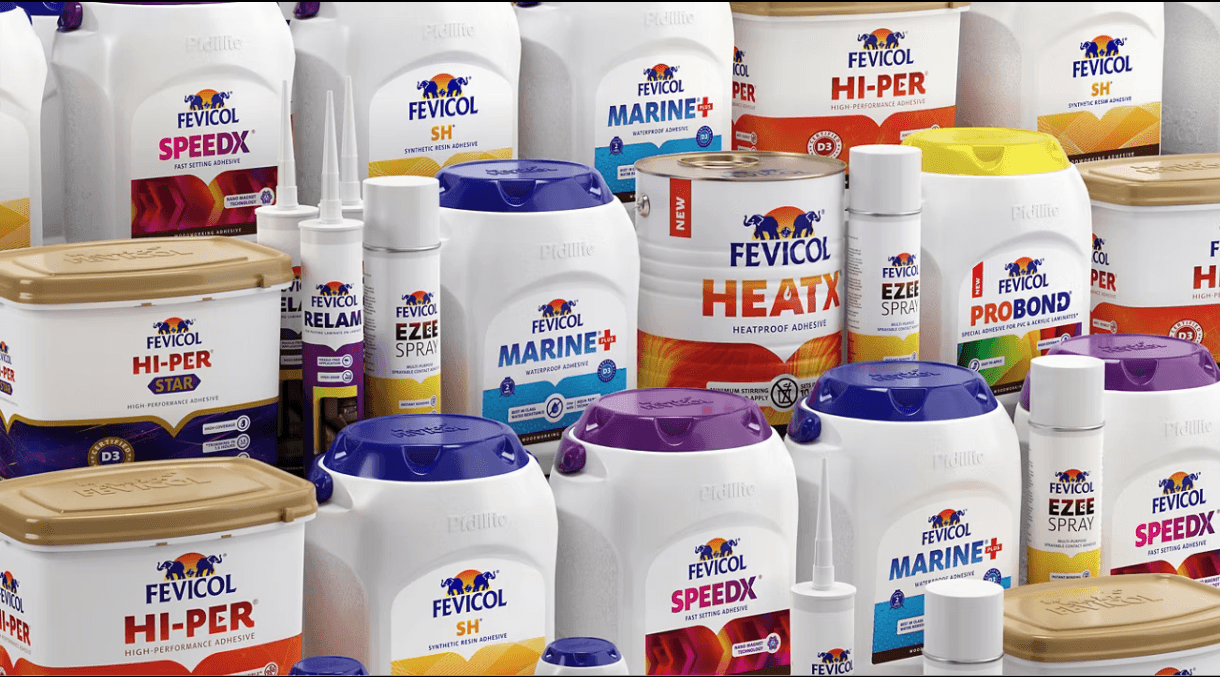
In India, something unusual happens when furniture breaks.
People don’t ask for glue.
They ask for Fevicol.
That small linguistic shift reveals one of the most powerful branding stories in Indian business. A product category that became synonymous with a single brand.
This is the story of how Fevicol turned a commodity adhesive into a cultural icon.
Welcome to Street Smart Brands — Day 8.
When Adhesives Were Just Commodities
When Pidilite Industries launched Fevicol in 1959, the adhesive market in India looked very different.
Adhesives were:
- Unbranded
- Sold in bulk
- Chosen almost entirely on price
There was little differentiation and almost no brand loyalty.
For most manufacturers, adhesives were simply a functional chemical product.
Pidilite saw an opportunity to turn that commodity into a brand.
Identifying the Real Customer
Most companies selling adhesives would instinctively target furniture buyers.
But Pidilite realised something critical.
Furniture buyers don’t choose the adhesive.
Carpenters do.
Carpenters are the real decision-makers.
Instead of chasing consumers, Fevicol focused on winning the trust of millions of carpenters across India.
That single insight shaped everything that followed.
Winning the Workshop Before the Living Room
Fevicol’s strategy was simple.
If carpenters trusted the product, homeowners would follow.
The brand built loyalty through:
- Consistent product quality
- Reliable bonding strength
- Easy availability in hardware stores
Over time, Fevicol became a default choice in workshops.
Once professionals adopted it, the brand naturally became the household name for adhesives.
This professional-first strategy resembles how brands like Lenskart focused on solving a real consumer frustration before scaling retail distribution, as explored in this analysis of Lenskart’s growth story.
The Distribution Advantage
Fevicol didn’t rely on large-format retail chains.
It focused on the places where carpenters actually shop:
- Hardware stores
- Timber markets
- Local construction suppliers
- Small-town retailers
This deep distribution network allowed the brand to penetrate thousands of towns across India.
Accessibility became a competitive advantage.
The strategy mirrors the distribution-led thinking that helped companies like OYO expand rapidly by targeting under-served local markets, as discussed in this breakdown of OYO’s expansion strategy.
Advertising That India Still Remembers
Fevicol’s advertising became legendary.
For over five decades, the brand consistently communicated one core idea:
“Mazboot jod.”
The campaigns combined humour with a single memorable message: strong bonding.
From overcrowded buses to unbreakable furniture jokes, Fevicol ads became part of Indian pop culture.
Instead of explaining chemistry, the brand demonstrated reliability through storytelling.
This consistency helped Fevicol remain memorable across generations.
That same clarity of messaging is something we see in other iconic Indian brands that simplified complex categories, similar to how Zerodha positioned transparency and simplicity in financial services, as analysed in this overview of Zerodha’s marketing strategy.
The Size of the Opportunity
The adhesive market itself is massive.
India’s adhesive industry is estimated to be worth more than ₹25,000 crore today.
Demand comes from multiple sectors:
- Furniture manufacturing
- Construction
- Packaging
- Home repairs
What began as a niche industrial chemical market has grown into a large, multi-industry ecosystem.
And Fevicol sits at the centre of it.
Category Leadership
Pidilite Industries now generates annual revenues of more than ₹14,000 crore.
Within the branded adhesive segment, Fevicol commands a dominant market share, estimated to be around 70 percent.
This level of dominance rarely happens in commodity categories.
But Fevicol achieved it by combining product reliability, deep distribution, and unforgettable advertising.
Consistency as a Competitive Advantage
Many brands chase constant reinvention.
Fevicol did the opposite.
For more than six decades it stayed consistent on three things:
- Product reliability
- Carpenter loyalty
- Brand storytelling
This discipline built trust over time.
Instead of chasing trends, the brand strengthened its core identity.
The result is one of the strongest category associations in India.
Why Fevicol Belongs in Street Smart Brands
Balaji mastered cost leadership.
Vahdam mastered global positioning.
OfBusiness mastered embedded finance.
Meesho mastered value commerce.
D-Mart mastered operational efficiency.
Royal Enfield mastered community.
Fevicol mastered category ownership.
When a brand name becomes the category name, the competition becomes almost invisible.
Final Thought
Fevicol did not invent adhesives.
It simply understood the market better than everyone else.
Win the carpenter.
Reach every hardware store.
Tell one memorable story for decades.
And over time, glue becomes Fevicol.
